
Regret
Longing for a different life

I love to read. I like to snuggle up with a hot cup of tea in the fall or winter with a good book, but I love to sit on a beach in the sun and read. This summer I plan to write my monthly newsletter about a book I’ve recently read and share what I’m learning and/or simply enjoying.
I just finished a novel in a genre that I don’t often read. My library labelled it as “Science Fiction” but others have called it “speculative fiction”. The book is The Midnight Library by Matt Haig.
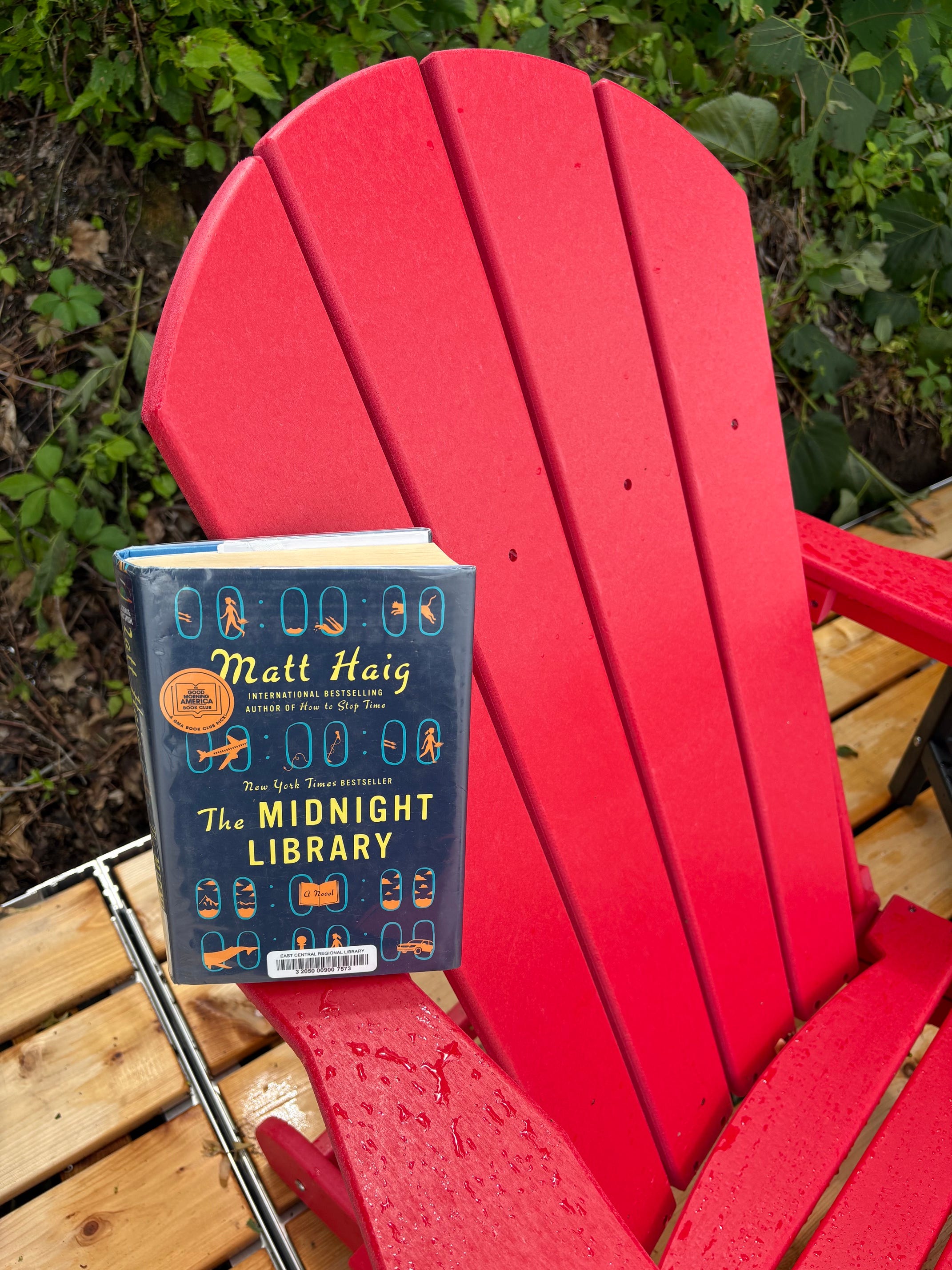
Here’s the introduction to the book from the author’s website:
Somewhere out beyond the edge of the universe there is a library that contains an infinite number of books, each one the story of another reality. One tells the story of your life as it is [your base life], along with another book for the other life you could have lived if you had made a different choice at any point in your life. While we all wonder how our lives might have been, what if you had the chance to go to the library and see for yourself? Would any of these other lives truly be better?1
There is one book in the library that’s different and it is “The Book of Regrets.” The main character, Nora Seed, faces the regrets of her “base life” and with the guidance of her mentor Mrs. Elm, she gets to try on a life she would have had if she had not made a particular “regrettable decision”.
Nora suffers from depression which led her to believe that her life was not worth living and so she decides to take her own life. In this gap (between life and death) she is taken to the midnight library. “She had managed to convince herself that there was no way out of her misery. That, she supposed, was the basis of depression as well as the difference between fear and despair. Fear was when you wandered into a cellar and worried that the door would close shut. Despair was when the door closed and locked behind you.” (p. 215)2
We all experience fear and anxiety at some point, but it’s that feeling of finality, a helplessness of not being able to change the outcome that leads to despair. When we think that our choices cannot or will not make a difference, we give up. We resign ourselves to our circumstances.
A little earlier in the story, Nora thinks,
“It’s so easy, … to imagine that times of sadness or tragedy or failure or fear are a result of that particular existence [or circumstances]. That it is a byproduct of living a certain way, rather than simply living. I mean, it would have made things a lot easier if we understood there was no way of living that can immunize you against sadness. And that sadness is intrinsically part of the fabric of happiness. You can’t have one with out the other. Of course, they come in different degrees and quantities. But there is no life where you can be in a state of sheer happiness for ever [sic]. And imagining there is just breeds more unhappiness in the life you’re in.” (p. 179) (emphasis mine)
We can believe that bad things happen because of our circumstances (where we live, our relationships, our work, etc.) but every life lived on this planet has times of sadness, tragedy, failure, and fear. Thinking that there is a life to be lived on this earth that has only happiness, success, fun, and assurance is an illusion. And being determined to have that version of life for ourselves only makes us more prone to unhappiness, discontent and despair because it is unattainable. We are more likely to recognize and appreciate happiness when we see it in contrast to sadness.
To Nora’s surprise, each life that she tries on isn’t any happier even if she’d married that guy, persisted with swimming to get an Olympic medal, became a rock star, studied glaciology instead of philosophy, or said yes to another man’s invitation to coffee.
She discovers a deep truth while experiencing one of her alternative lives:
“You could eat in the finest restaurants, you could partake in every sensual pleasure, you could sing on stage in Sao Paulo to twenty thousand people, you could soak up whole thunderstorms of applause, you could travel to the ends of the Earth, you could be followed by millions on the internet, you could win Olympic medals, but this was all meaningless without love.” (p. 248) (emphasis mine).
Despite the many philosophers quoted in the novel, here Matt Haig overlooks the most obvious (to me) and that is the Apostle Paul who wrote:
“If I could speak all the languages of earth and of angels, but didn’t love others, I would only be a noisy gong or a clanging cymbal. 2 If I had the gift of prophecy, and if I understood all of God’s secret plans and possessed all knowledge, and if I had such faith that I could move mountains, but didn’t love others, I would be nothing. 3 If I gave everything I have to the poor and even sacrificed my body, I could boast about it; but if I didn’t love others, I would have gained nothing.” (emphasis mine)
(I Corinthians 13:1-3, New Living Translation)
The purpose of life is love.
You are loved deeply and personally by the Creator of the Universe.
Love others and you will live a meaningful life.
I hope I haven’t spoiled the book for you but I would encourage you to make your next selection from a new (to you) genre and hopefully you’ll be surprised by a great story.
Have you read a good book lately? I’d love to hear about it.
If you’d rather not leave a comment, I appreciate your liking this post if you enjoyed it. Hope you have a summer filled with good reading.

All quotes from The Midnight Library are taken from the hardcover edition published by Viking in 2020.
THANK YOU Judi! I REALLY APPRECIATED this recap of the story about our individual misinterpretations of regret. [I don't read much, and ENJOY others sharing "with me" most of the time instead as a welcomed alternative.] I especially appreciated your point about the Apostle Paul's absolute understanding about the ultimate need for loving others.
I always find your insight relative and helpful, please keep it up. God bless you.